

Julius Robert Oppenheimer (1904-1967)
He was born on April 22, 1904. His father was a wealthy German Jew, an immigrant, and a textile importer in New York.
As a seventeen-year-old student at Harvard, he excelled in Greek and Latin, physics, and chemistry. He published poetry and was interested in Eastern religion and philosophy. After graduating, he went to England to conduct research at the University of Cambridge. In the Cavendish Laboratory, he worked under the mentorship of the great Lord Rutherford in a laboratory that already had an international reputation for research on atomic structure. Starting in 1929, he worked at the University of California, Berkeley, as well as at the California Institute of Technology, where he founded the graduate school for the study of theoretical physics. He trained an entire generation of American physicists who were impressed by his organizational skills and intellectual independence.
After the German occupation of Poland in 1939, two world-renowned scientists, Albert Einstein and Leo Szilard, warned the U.S. government that if the Germans possessed an atomic bomb, it would be a threat to the entire world.
Following the entry of the United States into the war in 1941, President Roosevelt organized a research group and asked J. Robert Oppenheimer, a member of this group, to lead a team of British and American physicists assigned the task of developing a nuclear bomb in a laboratory in New Mexico.
In 1944/45, the Allies’ efforts to defeat Nazi Germany intensified due to concerns from prominent politicians, military strategists, scientists, and leading intelligence officials. They believed that if Germany had enough time, it could gain an advantage in advanced weaponry technologies.
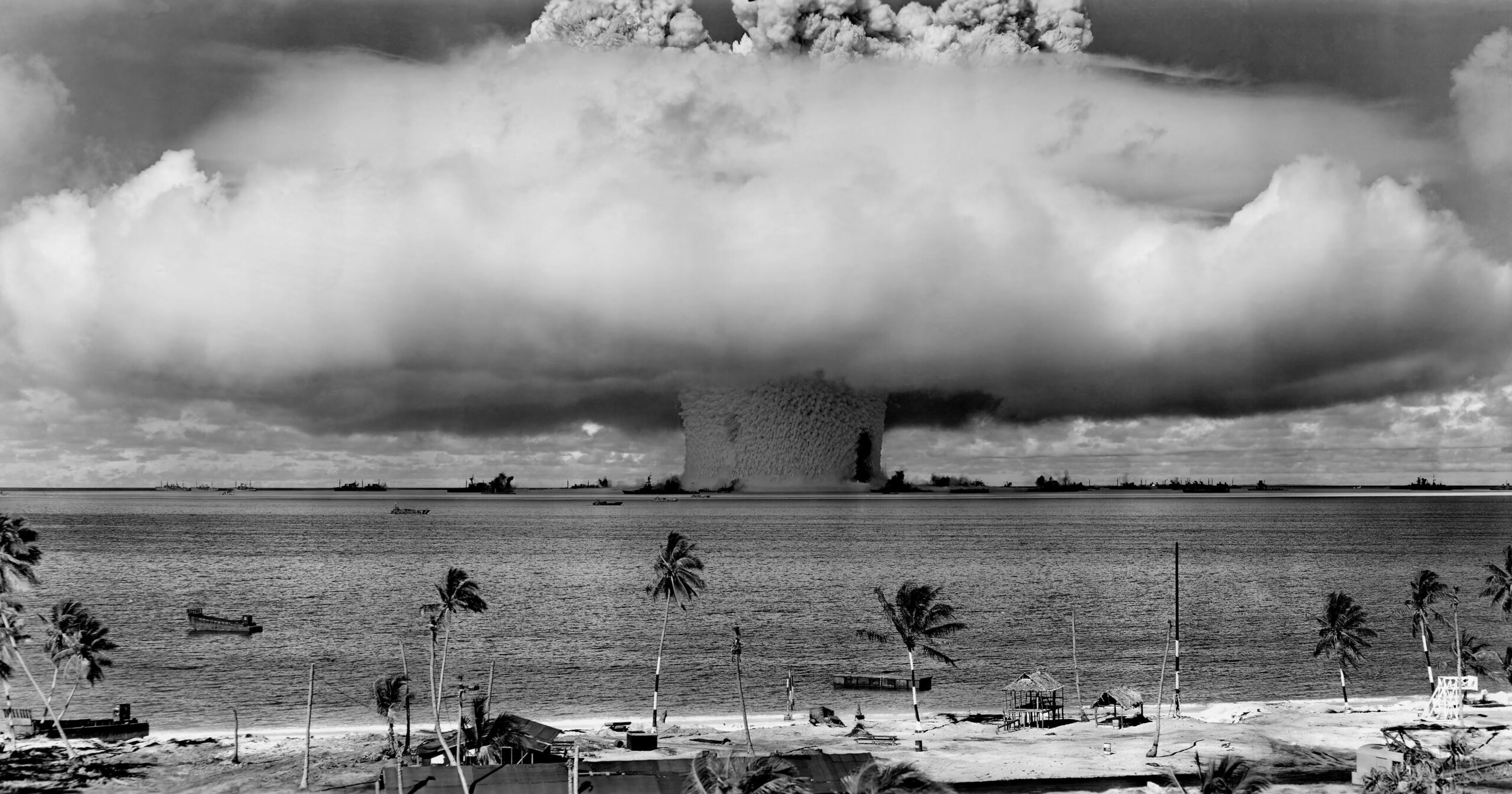
After the test of the first atomic bomb on July 16, 1945, in Alamogordo, New Mexico, Oppenheimer described the event: “We knew that the world would not be the same. A few people laughed, a few people cried, most people were silent. I remember a line from the Hindu scripture, the Bhagavad-Gita: ‘Now I am become Death, the destroyer of worlds.'”
In order to end a potentially long and exhausting war in East Asia, President Truman ordered atomic bombs to be dropped on the Japanese cities of Hiroshima and Nagasaki. Exact figures on the number of casualties are not available, but it is estimated that around 140,000 of Hiroshima’s 350,000 residents were killed in the explosion, and at least 74,000 people lost their lives in Nagasaki. The devastation was immense and horrifying, but the result was achieved, and Japan surrendered on August 15.
Three months later, in November 1945, Oppenheimer spoke with his fellow scientists and tried to explain why he and his colleagues had developed the bomb. He emphasized that the mere existence of the bomb meant that cooperation among nations would be more necessary than ever in the future.
“It is not possible to be a scientist if you do not believe that learning is good. It is not good to be a scientist, nor is it possible, unless you think that sharing your knowledge with someone who is interested is of the greatest value. It is not possible to be a scientist if you do not believe that knowledge about the world and the power it provides is of fundamental importance to humanity. To use it to help in the dissemination of knowledge, and to be willing to bear the consequences.”
“I understand that wars have changed… I understand that it will be very cheap to make. I understand that this is a situation in which a quantitative change and a change where the advantage of aggression over defense – attack over defense – where this quantitative change has all the characteristics of a qualitative change, a change in the nature of the world… I think that the emergence of the atomic bomb and the facts that will be overlooked, that it is not difficult to make… that its destructive power will grow and is already incomparably greater than the power of any other weapon – I think these things create a new situation, so new that there is some danger, even the danger of believing that what we have is a new argument for agreements, for hopes that existed before this development occurred. By that, I mean as much as I enjoy hearing advocates of a world federation or advocates of the United Nations who have talked about these things for years – as much as I like to hear that there is a new argument here. I think they miss the point partially, because the point is not that atomic weapons represent a new argument. There have always been good arguments. The point is that atomic weapons represent a new field, a new field and a new opportunity to achieve the prerequisites. I think that when people talk about this being not only a great danger but also a great hope, they should indeed mean that. I think they should not assume the unknown, although secure, value of the industrial and scientific virtues of atomic energy, but the simple fact that in this area, because it is a threat because it is dangerous, and because it has certain special characteristics, to which I will return, there is the possibility to achieve and begin to realize those changes necessary for peace. These are very far-reaching changes. These are changes in relations among nations, not only in spirit, not only in law, but also in understanding and feeling…”
“I believe that those who assert that atomic weapons are a danger affecting everyone in the world are speaking the truth, and that in this sense it is a common problem, just as defeating the Nazis was a common problem for the Allies. I think that if we want to address this common problem, we must develop a comprehensive sense of shared responsibility… What I want to say, what I want to deeply instill in everyone’s mind, is that there is a profound change in the state of mind at work here. There are things we consider precious, and I believe we are right to do so; the word democracy, I would say, describes one of them. In many parts of the world today, there is no democracy. There are other things we consider precious, and it is right that we do so. When I speak of the new state of mind that has emerged in international affairs, I mean that even in those things we hold dear from the bottom of our hearts, for which Americans have always been willing to lay down their lives – and certainly most of us would still be willing to lay down our lives – even then, touching on these deepest questions, we realize there is something even deeper, which is the connection that binds all people, everywhere in the world.”
“…We are not just scientists; we are also human. We cannot forget how much we depend on other people, on humanity as a whole… These are the strongest bonds in the world, even stronger than those that tie us to our close ones; yes, these are the deepest bonds – those that connect us to other people, to humanity.”
From 1947 to 1952, Oppenheimer was the head of the Institute for Advanced Study and chairman of the General Advisory Committee to the Atomic Energy Commission. However, on December 21, 1953, he was accused of earlier collaboration with communists, delaying the appointment of Soviet agents, and opposing the development of the hydrogen bomb. Although he was exonerated, he was barred from further access to military secrets. Meanwhile, his advisory contract with the Atomic Energy Commission was terminated. The American Scientists’ Association immediately defended him, protesting against the trial. Oppenheimer became a worldwide symbol of a scientist who, in his attempt to resolve the moral issues arising from scientific discoveries, became a victim of the witch hunt.
In the final years of his life, he focused on the idea of the relationship between science and society. As the Cold War entered other phases, President Lyndon B. Johnson attempted to rehabilitate him in 1963 by nominating him for the Enrico Fermi Award from the Atomic Energy Commission.
He died in Princeton on February 18, 1967, at the age of 64.

